Grayden, Jess, Lilli, and Louie have moved to the farm and are settling into the main farmhouse. The studio is completed and when the snow subsides Grayden will be able to finish moving in. We are planning a small family vegetable garden and will be ordering seeds this week. What a change from a few years ago! Grayden has ordered Christmas Trees seedlings to plant out for future Christmas Trees sales. It is something he is familiar with, because it was one of our farm enterprises when Grayden was growing up.

Ken has been doing maintenance on his skid steer loader and is cutting down beech trees for next year’s fire wood. Unfortunately, the beech trees in our woodlot are dyeing due to disease. It is important to take them down before the tree is totally dead and the limbs start falling off. Ken will get the horses back to work, after their winter break, skidding out the logs to be bucked up for firewood.

Ken is doing a presentation on his EFAO No-Till Organic Potato Trials later this month at the Ontario Fruit and Vegetable Conference. (I think it should really be called low-till…) He is also doing presentations to organic agriculture classes at the University of Guelph and Ridgetown Agriculture College. He still does a bit of consulting making recommendations to farmers on soil amendments for different crops after looking at soil test results. One of the more interesting projects was for some gardens in indigenous communities as far north as Fort Severn on James Bay.

I am gearing up for my next season of eco printing and natural dyeing. See the dates for workshops on the Indigo and Botanical Dyeing page of this website. I can feel my energy increase as the days grow longer, after enjoying a bit of hibernation in the winter months. Matching my physical work to the rhythm of the seasons is one of the things I enjoy most about the farming life style.

Greenhouse to Studio Conversion Complete. The hardwood floor is a mix of hard maple, ash, and black walnut from our woodlot.
Our Youngest Teamster in Training

A new era on the farm has begun with the emptying out of our greenhouse to make it into a studio for Grayden. Ken has promised to make a hot bed for bedding plants in the spring to take the place of the greenhouse. When Ellen and I began the CSA in the 1997 we used a hotbed to start our transplants. The horse manure heats up under the hotbed and keeps the plants from freezing at night. It is fun to think of coming full circle with this old method. It beats cutting a lot of extra firewood and having to stay up late to stoke the wood stove in the greenhouse. For a small garden it makes sense, however I would be lying if I didn’t acknowledge a degree of sadness at saying goodbye to the greenhouse and the many hours of joy that I spent there nurturing young plants. It was a wonderful space in the spring when was still cold and brown outside. I hope that the positive energy will carry over to make Grayden’s studio a joy filled space.

My nephew, Stefan, and the crew that he works with at M&D Contracting have been instrumental in moving the rennovation along. Some of the walnut, maple, and ash from our woodlot, that Ken sawed on his sawmill and stored, has been used for a beautiful hardwood floor in the studio. A local Amish woodworker processed the rough lumber into tongue and groove with three different widths. Ken and Grayden helped around the edges and worked on the siding and laying the floor. Ken is happy that he did our major building projects when his body was a few years younger.

Grayden and Ken putting on the siding

Walnut, Ash and Maple from the Woodlot Waiting to be Laid

Studio – Walnut, Ash and Maple Floor

We are starting a new chapter on the farm this fall. After 10 years on the farm Ellen, Aaron and their children, Della and Frannie have moved to Port Stanley, a near by village. Ellen has moved on from farming to becoming a therapist…what does that say about farming? However, I find getting my hands in the dirt and cooking to be therapeutic, so we will see what Ellen comes up with in the long run. Having 10 years with Ellen and her family next door when, the girls were little, was a blessing and we will continue to enjoy family time together.

Grayden and Jess and their children, Lillli and Louie are moving to the farm in November. Their current house is being expropriated to make room for a highway expansion northwest of St. Thomas. Since Ellen was no longer actively farming, she and Aaron decided to move off the farm and make room for Grayden and his family to move on farm rather than try and build another house here. We are in the process of retrofitting the greenhouse to become an art studio for Grayden and doing a bit of a face-lift or rather floor-lift in the main farmhouse. Yesterday, Jess and I sanded the kitchen and bathroom floors. The 35 years of hard use on pine floors was very evident!

On the farm front, Grayden is preparing to plant some Christmas Trees in the spring and ease into that aspect of farming. He has fond memories our small Christmas Tree business from his youth. We will continue to grow a range of vegetables for ourselves, but are planning on having all the gardens up near the houses next year. Ken will continue to custom graze beef cattle and keep his small herd of Suffolk Punch horses. I am enjoying my dye plant gardens and look forward to having more time to play with natural dyeing and eco printing.

Ken is taking a woodlot stewardship course and yesterday went to the woods with Louie to prepare for a presentation. We have one beautiful oak mother tree where Louie’s parents exchanged wedding vows five years ago. Ken took a picture of Louie under the tree…

Louie under the oak-wedding-mother-tree in the woodlot.

So here are some pictures and results from the Living Labs/EFAO’s 2023 trials with no-till organic potatoes. The side-by-side trial was done with 3 different varieties, Norland, SP327 and Gemstar Russet. There were 2 rows of each variety in a 60″ wide bed. The seed was planted 12″apart in the row. The 2 rows were 26″ apart in the bed. Not a problem in the no-till beds but a bit of a challenge to cultivate with a tractor in the tilled beds. So there were 6 rows in a tilled area next to 6 rows in a no-till section all replicated 4 times down the field. The 2 treatments were planted the same day. The no-till plots were planted into standing rye with a RJ Equipment transplanter into the standing rye which had been planted the fall before. The no-till plots were flail mowed when the first potatoes started to emerge. This provided enough residue to control weeds the whole season and protect the tubers near the surface from greening.The no-till plots were slow to emerge and were about 3 weeks behind the tilled plots. All plots were then dug with a 2 row 60″ wide. Willsie potato digger with optional carrot blades and side coulters. The results presented in the bar graph indicate that Norland had a statistically lower yield with no-till and may not be adapted to this production method. The other 2 varieties yielded just as well under no-till as tilled. The other trial involved testing a deeper planting depth to avoid greenig but it showed no significant difference in yield or greening with a planting depth of 5″ vs. 3″

Planting into the standing rye with the RJ Equipment no-till transplanter.
Flail mowing rye at the emergence of the first potatoes in the no-till plots.
Potato seed piece in the standing rye.
Digging 2023 No-till Plot
Some of the 2023 No-till Crop

For several years Ellen has been managing the posts in the “blog” as she was managing the retail vegetable operation at Orchard Hill Farm. The retail vegetable operation has now been retired at Orchard Hill Farm and we are now entering another phase. Ellen and her family are still here on the farm and Ellen has explained the changes on the Killdeer Food Page of this website. Ken is pursuing his passion for draft horses, soil health and improvement including exploring no-till techniques, cover crops and permanent pastures. Martha is enjoying growing a variety of dye plants and exploring the world of natural dyeing. Over the years Orchard Hill Farm has continued to evolve to suit the needs at the time and we feel fortunate to be able to continue to do so.

Ken spent has spent much of the winter attending and speaking at various meetings and conferences, mostly about his no-till organic vegetable trials. Stay tuned for more info about that. One of the great joys was to reconnect with Lisa Miskelly, an intern from 2011, at the Pasa Conference in Pennsylvania. Lisa now works for Pasa see following link: https://pasafarming.org/staff/lisa-miskelly/

Ken and Martha at Pasa Conference in Pennsylvania with Past Intern Lisa Miskelly

Courgette and Mosquito living their best winter life – they are no longer barn cats but breezeway cats – since Caesar’s departure, they have moved into the breezeway.

Life is slow this time of year – and the past couple of days of snow have made the wood stove and all of the food that we have ‘put by’ seem extremely luxurious. There’s status luxury and then there’s the luxury of well seasoned hard wood, heirloom canned tomatoes, your own dried beans and some homemade nocino. There are seeds to order (done), garden and greenhouse timeline to plan (in the works). I love crunching the numbers and calculating the season gone by and am always a little chuffed by how much we got done. The summer always seems a little inconceivable in the winter – these days I make food, do the dishes and tidy up a bit…and it’s like 7 hours later. How in the world do I do all those things AND manage the garden and greenhouse? Right now it’s mildly amusing but every year without fail I have a minor meltdown about it in April. I was complaining about it to a farmer friend last year and she was said – Look – the days are longer, your house will be a little dirtier and your meals will be more simple. You’ve done it before, it will be fine. And she was right. It’s just a different aspect of the seasons.

Sipping soup (using up the last of the squash, with rich chicken broth), garden planning.

The entire time growing up my brother and I begged for a puppy – it would be so cute! We would totally take care of it and everything, etc. I called a family referendum to negotiate for a pet and finally got a cat.  And then miraculously, when Grayden and I were off to university, mom and dad got a puppy, Caesar. Beloved by our parents and every CSA member and intern. Not the sharpest tool in the drawer by any means, but it wasn’t until this year when he couldn’t chase the hawks from the laying hens that I realized how much he did do around the place (we lost like 10 chickens). Over the years, his mild manners and predictability has turned many a canine-averse toddler into mere skeptics of any other dog. ‘The only dog I like is Caesar.’ 

I think his acceptance and approval of pick up days during the CSA was entirely based on the access to the floors of minivans (rife with snacks), errant baguettes and the dog treats brought especially for him. The last few years he’s dedicated himself to guarding Aaron’s 4-runner with an alarming passion. Sometimes we would have to strategically park it so that he wouldn’t bark at cars driving close to it for 4 hours because he would make himself hoarse. He would sit with Aaron for hours, and always begged for a ride in the back. 

May he go on many more walks, eat all the treats and chase hawks and cats on the other side. Thank you for sharing your life with us, Caesar.  

Caesar and Mosquito Waiting for a Wagon Ride

Caesar is Eagerly Awaiting the Start of the CSA Season
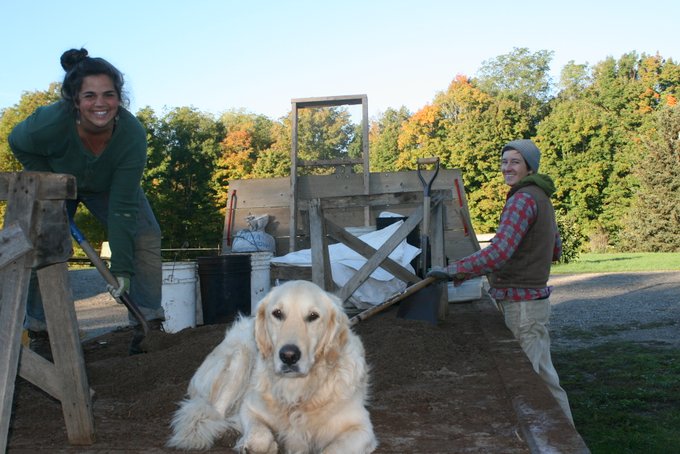
Jayme and Caitlin Making Potting Soil with Caesar Supervizing
Martha and Caesar
Transplanting Onions with Help From Robin Grindley – CSA member
Apprentice Team in the Cabbage Patch with Caesar
At the End of a Big Day Gathering up Row Cover
Jean Francios Inglais
Martha and Caesar Sorting the First Seeds for 2013
Caesar enjoying a Carrot in the Field as he Suppervizes
Introductions Caesar and Mabel
Linning up the Logs to be Pulled Out
Caesar enjoying the ride.
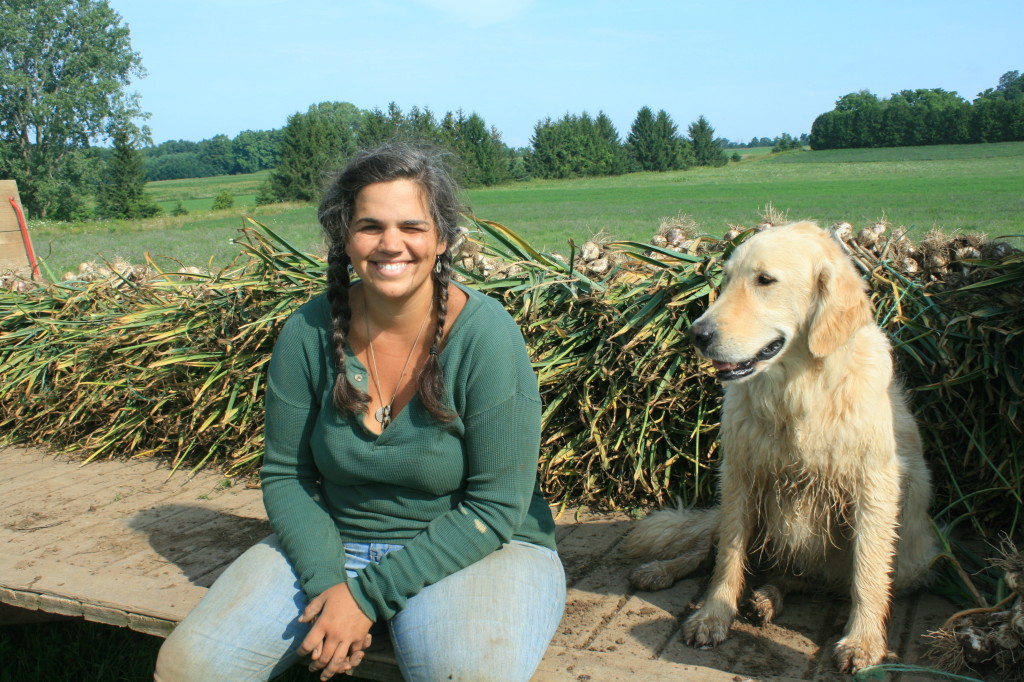
Jayme and Caesar Relaxing after Gathering in the Garlic
Michelle and Caesar

 I make lunch for our work crew every day. It takes time, and there are more dishes, and I have to plan ahead if I want to make anything involved. But I make the time and we do the dishes because it’s worth it – we connect, rest & recharge. And sometimes we just have salads with stuff on top. It’s fun for me to think strategically and cook for grown ups, challenging to balance all the dietary restrictions, and gets me deeply in the seasonally cooking. I worked in quite a few kitchens before I worked at one that had staff meal, where we actually took time to sit down and eat a meal, with forks and knives and napkins – and I think we made better food because of it. We tasted things together and talked about what which dish we liked the best, and what needed a little more salt – we defined our palates as a group. On the farm, as in the kitchen, we work hard – but one of the perks should be that we eat well. So we sit down to lunch, we eat the first handful of green beans, and crunch the first cukes. It also serves as a reminder to me that not everyone has worked in French restaurants – what we plant and weed and harvest – it brings it all together if you also know the pleasure of crunchy fennel in a potato salad, or radicchio and endive with a poached egg.  
New This Week – White baby new potatoes, the first cucumbers, golden beets, baby carrots (online only, no market), tatsoi & mustard bunches, Arugula & White Bean Soup (with fennel), Potato & Fennel Soup with roasted garlic scapes.
Next Week – Broccoli, more green beans.   Have a great week and thanks for all the support – Ellen

Got some green things in the fridge that you need to use up? Same old dinners getting tired? Make a pesto! I love a pesto – I go into detail below. Once it’s in the fridge you’ll wonder what you did without it.

We are busy on the farm – the change in the weather is welcome – it was feeling mighty chilly there for a few weeks. But now we have to set up irrigation! The small plants and the freshly planted seeds need moisture to get established and it’s been a little dry for a little too long.

Ken has been working (in his ‘retirement’) on some research projects with EFAO and Living Labs – so we have insect tents set up around the farm, researchers are running tests on what might set back wire worms in potatoes, Ken has set up cover crop trials for different crops, and they have been doing extensive testing on our soil. One of the interesting things that came out of the tests is that our farm had zero levels of pesticide residue. Seems like a no brainer, right? That was my thought – we have been using organic practices for about 30 years, I would hope there are no pesticide residues! But ours was the only farm that had zero, and I’ve come to find out it’s actually kind of unusual. Ground water run off, spray drift & residues that reside in the soil from previous applications could all contribute.

Pesto Template

I’m a little loose with my definition of pesto – you could call it green sauce, sauce verte or pistou if you’re feeling French, zchoug if you’re feeling middle eastern. Once you have it in the fridge you’ll find a million ways to use it – this week alone we had an arugula-cilantro pesto on a lentil soup, in a potato salad, as a dip for roasted potatoes, and finally, mixed into some yogurt and mayo as a kid dip for cucumbers.

Step One: Choose your greens (about 2 cups, rough chopped)

All the flavorful green leaves and soft herbs work – arugula, parsley, basil, cilantro, tarragon, watercress. I love a spicy green like arugula with cilantro because the flavors lift each other up. Tarragon is a pretty strong one but a small handful makes it taste very Paris-in-the-spring and tastes great with asparagus. Equal parts parsley and cilantro bring a middle-eastern vibe.

Step Two: Choose an allium (1 tsp-2 Tbsp)

Garlic is classic, green garlic works great because it’s nice and mellow. Minced shallot or green onion works well if you want the greens to shine rather than garlic flavor – also will make it feel more French. Wild leeks are fantastic. Add roasted, grilled or sautéed onion for a sweeter, saucier, richer taste.

Step Three: Toasted Nuts/Seeds/Cheese (1/4 cup)

These are optional! I often use pumpkin seeds, or sunflower seeds, but pine nuts are delicious too. Cheese – try parmesan if you’re traditional, but also try something unconventional like goat cheese!

Step Four: Salt (1/2 tsp)

Throw it all in the food processor (or mortar and pestle if you’re feeling old school), and pulse it until everything is coming together and getting chopped up. Drizzle in:

Step Five: Olive Oil (1/4-1/2 cup)

Just add it until it’s the consistency you like. Taste for salt.

Optional –

Spices (1/4-1/2 tsp) – I like to add toasted and ground coriander and a pinch of cumin to any pesto with cilantro in it, sometimes a dash of hot pepper, or hot sauce.

Lemon (or Lime) zest and/or juice – Add the juice of a lemon or lime and taste how it brightens the flavours!

Make one up and tell me all about it.

Good morning! 
Pre-orders through the online store will open next week on 
Tuesday, April 27th at 8am. 

Order Tuesday/Wednesday, and then pick up your order at the farm Friday (in the old pick up room attached to the house) or at the Covent Market Saturday! Or just come by and say hi at the market Saturday May 1st at the outdoor farmer’s market 8am-1pm.  

As always, the season starts slowly – you all know it was chilly this week, but we will see some asparagus in just a few weeks, sooner if the weather cooperates! And rhubarb a week or so after that. But we will have spinach, salad mix, radishes, green garlic and other treats of the season.

Frozen soups – 3 bean Chili, Spring Greens & Pork soup, Chunky Veg with Chickpeas & Ginger, Kohlrabi & Sausage with Tomato, Pastured Chicken Broth.  
Frozen whole hog sausage from our own pigs – sausage is generally made from all the leftover bits, but this is a sausage made from one whole hog – I think it holds shape better and has better flavor.  Plain, garlic & breakfast sausage. 
Plants – at first we will have some of the hardiest seedlings (broccoli, cauliflower, kale, lettuce, calendula and parsley), because we are still liable to get a frost until the latter half of May, and some sensitive types (tomato, basil, pepper) can’t handle it. As the season progresses, we will have more variety of seedlings. 

You’ll see Seth’s Bread, Darryl’s Maple Syrup and our own organically fed pastured eggs. We got a new batch of laying hens, so we will have small (they’re like practice eggs for the first few months) and large eggs. 

And Suzy had her foal! It’s a filly named Kelly and she’s doing well – she spends all of her time on pasture with her mama at this point, glued to her mother’s side. It’s lovely to have new life on the farm.

Have a great week and thanks for all the support! Ellen
Greenhouse is starting to pop at the seams!
Kelly with her mom, Suzy