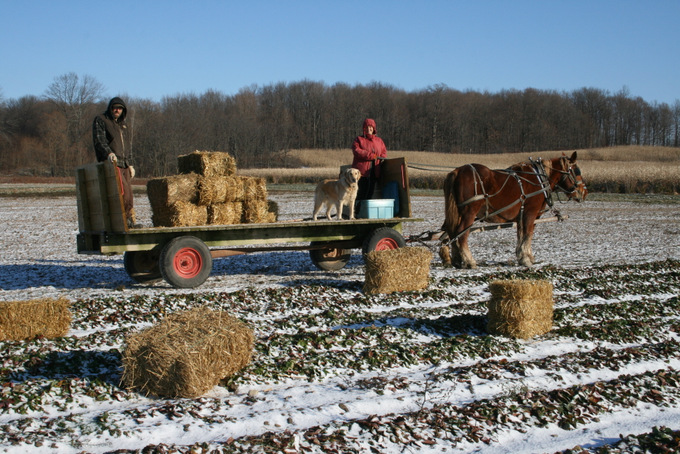
January came and went and February is almost over! We have had a busy snowy winter filled with all the usual winter activities: hiring interns; farmer meetings and conferences; reading and stoking the fire as well as CSA seed ordering and garden planning. Ken has been busy sawing lumber and getting the horse tread mill /flour mill set up. It is almost ready to try out. We will have to have a special post just for that! I have been perfecting a sourdough bread recipe that uses 100% Orchard Hill Farm sifted whole wheat flour. A u-tube video is coming soon…
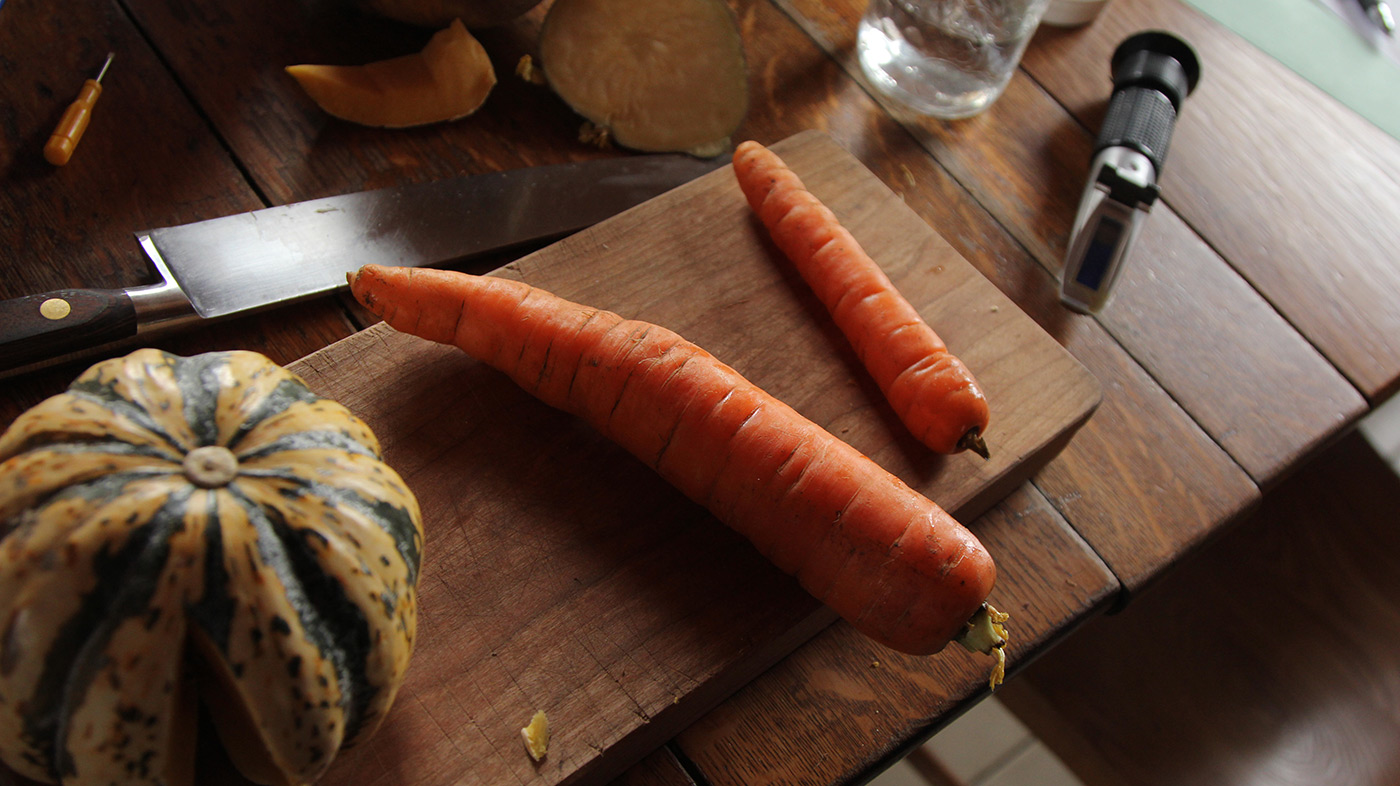
Ken continues to study soil plant nutrition and as always he is striving to find ways to improve the nutritional quality of the food we produce on our farm for our CSA. This week we got out the refractometer and measured some of our stored vegetables with a Birx test (measure of sugar and minerals in the juice of the fruit or vegetable or the sap of the plant). One carrot was 6.5 (a little better than average) and the Sweet Dumpling Squash 12.5 ( between good and excellent).
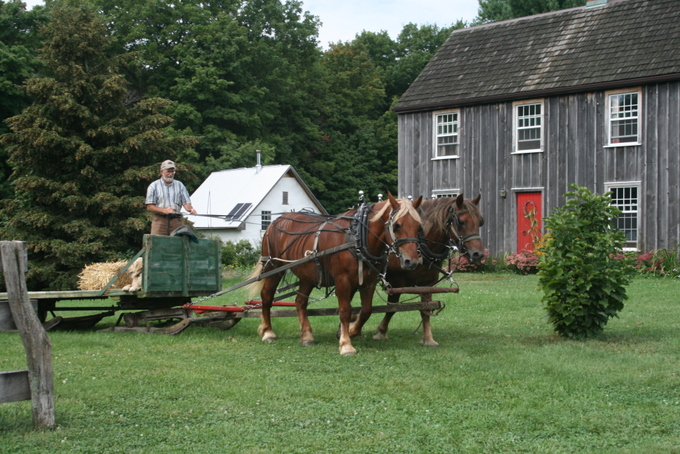
Our Suffolk Punch horses are wintering well. The frozen ground and snow pack make for a good winter paddock. It is much better than a muddy wet winter. Eli, our young Suffolk Stallion, is coming three this year and is proving to be a very well mannered sensible horse. He is running with the herd and they are all getting along. We installed wooden floors in all the standing stalls with ash from our woods, that Ken was able to saw himself. It made mucking out today easier and should be better for the horses legs when they are in their stalls.
Our son, Grayden, has moved back home and plans to work on the farm part time this season. It is great to have him around and we look forward an upswing in the quality of the photo record of the farm as he adds his professional skills in that area. (He took the photos for this entry and formatted them.) We also anticipate a good season with an able team of interns we expect the first three to arrive the last week of March. The fourth is coming in May, after her schooling is finished.
Our big news on the Suffolk front is that we are going to host the American Suffolk Horse Association Annual Meeting here September 12-14. Ken has been dreaming up lots of fun activities for the horses. We will be inviting Suffolk owners to bring horses here to show off and participate in events. Suffolk horses are a rare bred and it is exciting to have and event in Ontario to celebrate the breed.
Squeezing Carrot Juice into RefractometerKen Reading the RefractometerBrixTable
Mulching StrawberriesMulching Done with Bill’s Help Too!
As the year draws to a close one job that always needs doing is tucking in next year’s strawberries for the winter with mulch. As we were working at the job, I realized that Ken and I have mulched strawberries every year since 1978, when we grew our first plants. It is one of the most consistent annual farm jobs of our farming careers. Completing the farming year with a familiar annual task is satisfying. I enjoy the change of pace that goes with the seasons and our farming life, the rhythms and patterns are somehow reassuring. Now I am ready to turn my focus inward and enjoy nesting, holidays and a bit of hibernation before I start ordering seeds and planning next year’s garden.
Last Fall CSA Pick-up taken by Jim ConradLast Fall CSA Pick-up taken by Jim ConradLast Fall CSA Pick-up taken by Jim Conrad
We managed to have a beautiful last Fall CSA pick-up despite the big snow that proceeded it. CSA member, Jim Conrad, helped us out with all the Fall pick-ups and was ready with his camera on the last day. I am happy he was able to get some pictures of the beautiful array of produce before the pick-up began.
Ken and Bill have been sawing logs and the”backlog” is finally beginning to go down a bit. After the Fall CSA ended Ken and I took off for a week in Oregon to visit our daughter and her family. While Ken was there he toured some wood working and lumber businesses and was inspired by the beauty of wood and what can be made from it.
I have had time to hunt up some recipes and found a corn muffin that uses squash! It is quite yummy. The last time I made it I used sweet potato instead of squash and that worked well too. It is from The Cook’s Garden Edited by Liz Primeau (Canadian Gardening Collection).
BUTTERCUP CORN MUFFINS
1 cup cornmeal
1 cup all-purpose flour
1 3/4 tsp baking powder
1 tsp baking soda
1 tsp salt
1 tbsp. chopped fresh marjoram or oregano
1 tbsp. chopped parsley
1 or 2 green onions, finely chopped
1 cup fresh or frozen (thawed, drained) corn
2 large eggs
3/4 cup plain yogurt
3/4 cup olive oil
1 cup mashed, cooked buttercup squash
Preheat oven to 425 degrees. Lightly butter muffin tin and set aside.
In large bowl, combine cornmeal, flour, baking powder, baking soda, salt, marjoram, parsley, green onions and corn. Stir together well, then set aside.
In another mixing bowl, beat eggs together lightly, then incorporate yogurt and olive oil. Blend in squash until mixture is smooth. Add squash mixture to the cornmeal mixture and stir until well incorporated, but do not beat heavily.
Spoon mixture into muffin cups about 2/3 full. Bake for 25 to 30 minutes, or until browned and a tester emerges cleanly. Let cool for a few minutes in the muffing tin. Serve warm with butter and red pepper jelly.
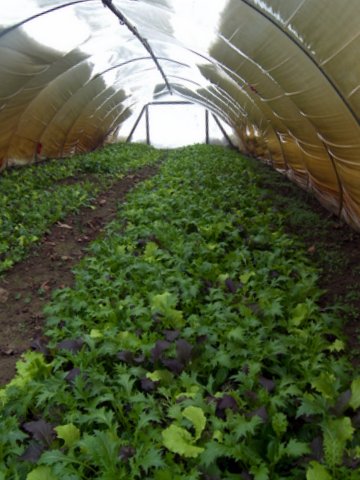
Hoop House “B” Unharmed will save the day. Providing Greens for our last Fall CSA Pick-up.
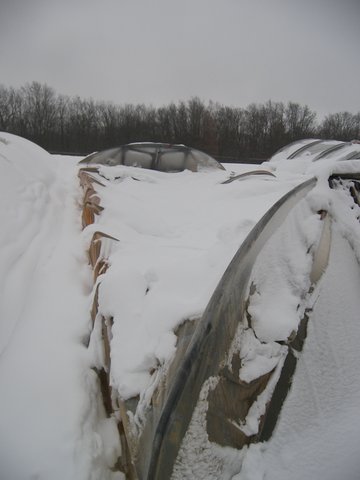
We have been moving snow for the past two days after the 30 inches we got on Saturday night. Fortunately, we have the root crops for next Saturday’s last Fall CSA pick-up all dug and in cold storage! We will be digging kale out of the snow later in the week and harvesting salad greens from under one collapsed hoop house. The weight of the snow was too much for it! Yesterday, we took a team of Suffolk Punch horses out to break a trail with the big bob sled and they were so worn out from ploughing through the snow that we had to turn around before we reached the main garden area and head back up to the barn. The snow has settled somewhat today and we are expecting to be able to make it down to the garden by the end of the week.
I have had my eye out for onion recipes because we have had such a bumper crop of onions. The following two recipes are from Small-Batch Preserving by Ellie Topp and Margaret Howard.
Caramelized Red Onion Relish
Balsamic vinegar is the magic ingredient in this recipe. It adds a pungent sweetness to the caramelized onions. Serve with barbecued or broiled meats such as steak, lamb chops and chicken.
2 large red onions, peeled
1/4 cup firmly packed brown sugar
1 cup dry red wine
3 tbsp balsamic vinegar
1/8 tsp each: salt and freshly ground pepper
1. Slice onions into very thin slices. Combine onions and sugar in a heavy non-stick skillet. Cook, uncovered, over medium-high heat for about 25 minutes or until onions turn golden and start to caramelize, stirring frequently.
2. Stir in wine and vinegar. Bring to a boil over hight heat, reduce heat to low and cook for about 15 minutes or until most of the liquid has evaporated, stirring frequently.
3. Season to taste with salt and pepper. Spoon into clean jar and refrigerate to use within 3 weeks or freeze.
Caramelized Red Onion and Tomato Pizza
This tasty appetizer is easily prepared using Caramelized Red Onion Relish
1/2 cup Caramelized Red Onion Relish
4 individual pizza crusts
1 medium tomato, diced
2 cups shredded mozzarella cheese
Divide onion mixture among pizza crusts, spreading evenly. Combine tomato and cheese; sprinkle over onion. Bake in a 350 degree F oven for about 10 minutes or until hot and cheese is melted. Cut each pizza into 6 wedges.
It’s hard to believe that we are already at the end of the Spring/Summer CSA season! Yesterday, it felt more like July with the hot dry weather. I guess we are making up for the cool spring. Our squash harvest has been more drawn out than ever before, while we wait for some of the squash to ripen in the field. It got off to a slow start in the spring and has needed the warm sunny weather of the last week to catch up. We are planning on bringing all the remaining squash up today. Yesterday, we finished digging the last six rows of potatoes and the field has been disced. The popcorn and ornamental corn was all picked too. Gradually, we are finishing up all the big fall harvest jobs and then we have the garlic to plant and the winter fire wood to bring up to the woodshed. Our pick-up room doubles as our wood shed. Once the main season CSA is finished we fill it up with firewood. The greenhouse is used as our Fall CSA pick-up room, because it doesn’t freeze. The produce for the Fall CSA looks great and we are looking forward to abundant harvests of stored and fresh picked produce throughout the fall. Today, we will plant a couple of the hoop houses for fresh baby greens to add to the in November pick-ups. I enjoy the challenge of extending the season and the fresh picked fall greens have such full flavour they are a big hit. We still have a few spots left in our Fall CSA.
We are accepting applications for the 2014 Spring/Fall CSA – Click the following link: Orchard Hill Farm Application
Ken and I had a wonderful trip to Vermont and saw about 30 Suffolk Punch Draft horses on our travels. Considering it is a rare breed that was quite something. We also had fun visiting Jolianne and Jonathan, two of our past apprentices and seeing their CSA farm operation Ferme Melilot in Quebec. (www.fermemelilot.com). It’s amazing how quickly they have advanced considering how long it took us to find our way forward with our CSA farming. It is a tribute to the individuals, but also demonstrates the great benefit there is in farm apprenticeships. On route we stopped off at Prince Edward County and I picked up a cookbook with some seasonal recipes that looked good. Here are a couple adapted from The Miller’s House Cookbook by Robert Simpson:
GRATED RUTABAGA CAKES
1 lb rutabaga, peeled
1/2 lb baking potatoes
1/3 cup all-purpose flour
2 eggs, lightly beaten
1 egg yolk
1/2 cup thinly sliced green onion or cooking onion
1/2 cup vegetable oil
Coarsely grate the rutabaga and potatoes. In a kitchen towel squeeze the grated vegetables to extract the excess liquid. In a bowl toss the grated vegetables with the flour, stir in the whole eggs, egg yolk, onion and season the mixture with salt and pepper.
In a large skillet heat 2 tbsp of the oil over moderate heat until it is hot but not smoking and in it fry rounded tablespoons of the mixture in batches, flattening the cakes with a slotted spatula, for 1-3 minutes on each side, or until they are golden and tender. Transfer the cakes as they are fried to a warm heat proof platter, and adding more oil to the skillet as needed. If necessary,reheat the cakes before serving.
yield: about 20 cakes
SWEET POTATO SOUP
1/2 cup onion, finely chopped
1/2 cup leeks, finely chopped ( add 1 cup onion if you don’t have leeks)
1 large cloves garlic, minced
2 large carrots, sliced thin
2 tbsp unsalted butter
1/2 lb sweet potato (2 medium size)
1 baking potato
2 1/2 – 3 cups chicken broth
1/2 cup white wine
3/4 cup water
Cook the onion, leeks, garlic and carrots in the butter over moderate heat, stirring, until the vegetables are soft. Add the sweet potatoes, baking potato, broth, wine and water and simmer the mixture covered for 15-20 minutes or until vegetables are very tender.
In blender puree the mixture until it is very smooth. Add additional broth to thin if necessary. Season with salt and pepper to taste.
Digging Sweet Potatoes with our Horse Drawn Potato Digger
We tried the horse drawn potato digger to dig our sweet potatoes and it worked like a charm! The sweet potatoes are now curing in one of our hoop houses. They are different than any other vegetable because they need heat to get sweet instead of cold.
We are heading into the last few weeks of the 2013 Main Season CSA and I wanted to make sure everyone knew the last pick-up days and the date of the CSA Pot Luck:
Last Saturday Pick-up: October 5
Last Tuesday Pick-up: October 8
CSA End of Season Pot Luck: Sunday, October 6 – (2:00-4:00 p.m.) Bring food to share, plates, cutlery and lawn chairs. We will have horse drawn rides after the food.
After a backward cool spring it has turned into a bountiful year for the garden with record harvests of many crops. In our CSA, you as members, share the risk with us, the flip side is us sharing the bounty with you – so help yourselves to the “extras”.
Pick-your-own fall Raspberries will continue until the end of the season or until we have a killing freeze. We will be harvesting the first of the fall carrots on Saturday and they are the sweetest of the season. Yet to come are celeriac, rutabaga, parsnip, brussels sprouts, chinese cabbage and winter radish along with the full complement of squash and pumpkin. I have done a back search of some of the great recipes on our blog and linked to them for you to refer to. I think it is a soup time of year. When we give celeriac don’t be afraid of it’s ugly appearance, because it is truly lovely in soup. The Potato and Leek Soup #1 recipe also gives great directions for cleaning leeks. When the rutabaga and parsnip appear I always make Winter Warmer Soup. Even if you aren’t a fan of strong flavoured root vegetables, in this recipe they all blend together deliciously with a hint of ginger and lemon. These soups are always better the second day, after the flavours have had a chance to blend, so you can make them ahead and enjoy them later when you are too busy to cook! Pumpkin Honey is a lovely spread on pumpkin muffins. It has the consistency of apple butter with lemon/pumpkin goodness. Pumpkin Custard is one of Ken’s favourites. It is like a good pumpkin pie without the soggy crust. Keep in mind that any pumpkin recipe can be made with squash. Kale Chips with Cashews are deluxe and also call for a red pepper. You can freeze peppers and use them in the winter in this recipe. No need to blanch them just take out the seeds and freeze. Chocolate Beet Cake is rich and moist and is also better the second day. I love the Roasted Beet – Arugula Salad. Really, I just love fall with the golden sunlight, harvesting the fruits of our labours and all the wonderful full flavours of the roots and greens. When the cold weather comes the starch in many plants turns to sugar and makes them deliciously sweet.
Ken and I are travelling to Vermont next week to attend 2013 Draft Animal Power Field Days, where Ken is giving a workshop on Horse Powered CSA. The apprentices will be running the show here at the farm. If you need to contact them please phone: 519-775-2670 for the pick-ups of September 24, 28 and October 1.
We have only 10 shares left in the 2013 Fall CSA. If any of you want to continue enjoying the rich tastes of the fall produce, and haven’t already signed up, now is your chance!
We have been busy harvesting. The onions are all out of the field and curing in two of our hoop houses. We dug another eight rows of potatoes last week and hope to finish the job next week. The horse drawn potato digger is working well and the yield of potatoes is good this season. We have had a bumper crop of peppers. They were a bit slow to ripen, but now are pouring in. We have missed frost on two nights so far and hope that it holds off for a while so we can keep on picking those beautiful red, yellow and orange peppers! We need to harvest the sweet potatoes before frost as well. The squash vines are starting to dye back. It is fun to see all the squash and pumpkins emerge, that were hiding under all the foliage. The outdoor tomatoes are finished now, but we will keep on picking the hoop house tomatoes. The hoop house cucumbers have been removed to make room for a planting of spinach for the Fall CSA. Our haying is finally over for this season. We put the last of the second cut hay in the barn on Tuesday. It feels like the main season is wrapping up quickly!
Lots of Sweet Peppers
Ken has had time to start training two of our Suffolk Punch horses. Sandy and Eli are both coming along well. I look forward to having a barn full of trained horses. Caesar is always happy to ride along on the sleigh during training sessions. The sleigh in the summer is a hard pull and helps keep the new horse under control. It is also a good way to get them used to the sound of something behind them, especially when the sleigh runners are on the gravel lane-way!
Ken and Caesar Training Sandy (on left)Sandy with her mother Suzie
Once in a while the old tongues on our horse drawn equipment break and need replacing. Ken has cut out some blanks with his saw mill that can be used to make new ones. Bill has had the job of making two new tongues this week.
The season is unfolding and we are enjoying harvesting many of the crops that we have nurtured along all season. Our potato crop is very good this year. After several years of preparation all our planning is paying off. A number of years ago we decided to grow our high fertility crops in a rotation with each other so that we could bump up the fertility and then take advantage of it the next season as well. The rotation is potato – squash – sweet corn followed by one year of green manure cover crops to replenish the soil and smother weeds before we begin the rotation again. Initially, we planted the blocks beside each other only to find that we had a major potato and cucumber beetle problem. The insects wintered over in the soil and just moved “next door” for a feast the following season. To solve the problem we kept our rotation, but moved the blocks about 1 kilometre from each other. This year we had no potato beetles in the potatoes and the cover crops that were planted the year before, as well as Ken’s cultivation with the horses, resulted in no hand weeding or hoeing in the field until last week when we did a quick once over to pull a few weeds that had escaped!
Hoop House Tomatoes, Beans, Eggplant and Cauliflower
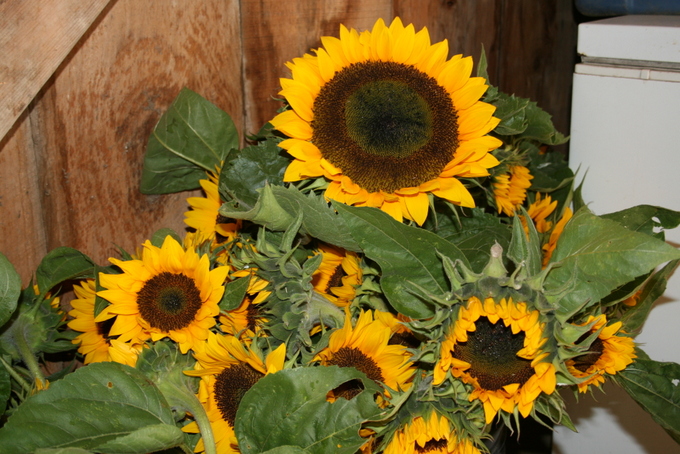
The out door tomatoes and eggplant are slow to ripen with our cooler summer, however hopefully the warm weather this week will bring them along. We had a nice crop of sunflowers for bouquets this year and enjoyed their cheerful presence in the pick-up room.
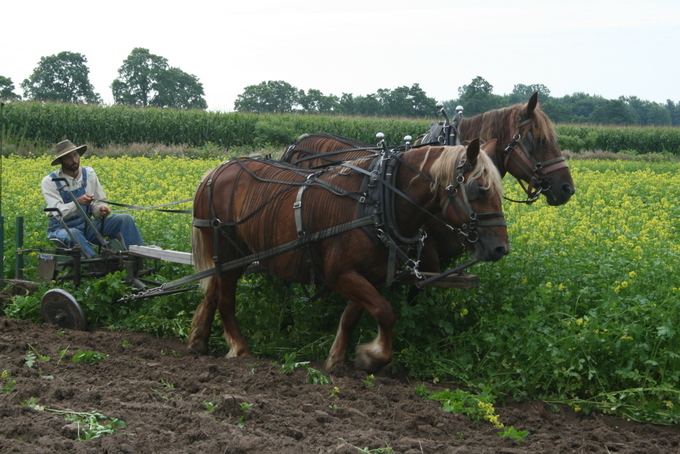
Sunflowers for our CSASam Ploughing Down Mustard Cover Crop with Suffolk Punch Horses
Each year our apprentices have a field to manage. They take soil samples, study the results to decide how to prepare the soil for the crop we are planning to grow and do all the field work that is needed. This year Sam’s field is the area that will be our main garden in 2014. All season he has been working getting the field ready. He ploughed down a hay cover crop, planted a cover crop of mustard, ploughed in the mustard, cultivated, spread the compost, cultivated the ground again and planted it to buckwheat, all using our Suffolk Punch horses. The whole process develops his teamster skills and helps to instil an awareness of the importance of preparing the soil for crops as the foundation of organic agriculture.
Horse Drawn Sprayer in Action
This season we invested in a horse drawn sprayer. Our garden has out grown the back pack sprayer, that we used in the past. Sprayers in themselves are not bad it is the materials that are used in them that determines whether they can have detrimental effects on the farmer , consumer and the environment. Some micronutrients like boron and molybdenum are best applied by spraying as it lets you distribute very small quantities evenly over the soil. We also use it for applying foliar sprays of fish emulsion. There are also organically approved botanical and biological sprays like pyrethrum, bacillus subtilus and spinosad that we use for some insect and fungal pests. Our draft horses are getting used to the noise of the motor that runs the sprayer as they walk along. However, we have to be careful which horses we use when we spray fish emulsion…if they aren’t used to it one whiff and it can be the start of a run away! Spraying a friendly bacteria on our summer squash has resulted in the friendly bacteria out competing the downy mildew that in the past has all but killed off our summer squash by this time of year. As a result, we have had a bumper crop and are starting to pick some of them when they are 3-4 inches long for “baby squash” to try and reduce the volume!
Bill still has some frozen chickens for sale and our CSA member Deb Atkinson has shared a Chicken Curry recipe that her family enjoys that uses cabbage. Our next batch of cabbage and peppers will be ready soon to go with the recipe!
Crockpot Chicken Curry
Ingredients:
3 Chicken Breasts
2 cans coconut milk
Red Curry paste (I got it at Superstore)
1 small yellow onion
1 green pepper
1 red pepper
½ head of cabbage
Put all the ingredients in the crock pot and stir (put all the stuff in the crockpot the night before as my
Mornings are busy and all I had to do was take it out of the fridge and plug it in. Turn on crockpot to
Low heat if you will be gone all day or high if you want it done earlier for lunch.
ENJOY!!! My kids really liked it, as it wasn’t spicy but a nice mild sweet flavour.
Heat the butter in large saucepan & saute onions & garlic until soft. (don’t let brown). Add broth, cucumber, swiss chard or spinach, potato, lemon juice, salt & pepper. Simmer, covered times 10 minutes till potato is soft.
Either put batches of the mixture thru the blender or food processor to puree. Transfer mixture to a bowl. Add more spices if desired. Let cool. Add cream and serve in chilled bowls.
Enjoy!
EFO Field Day at Orchard Hill Farm Horse Drawn Cultivator in ActionRaking Wheat Straw
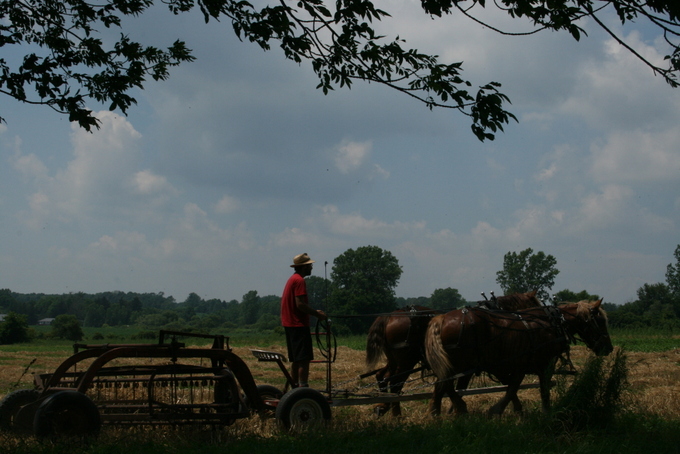
Every week continues to be filled up with events here at Orchard Hill Farm. On Wednesday, July 17th we had a Ecological Farmers of Ontario Field Day to demonstrate how Draft Horses can be successfully used for a small vegetable operation. It was an interesting day for participants despite the intense heat! Bill raked the wheat straw at the same time and we were able to get it into the barn the next day without any rain on it! The apprentices enjoyed throwing around straw after the heavier hay of the week before.
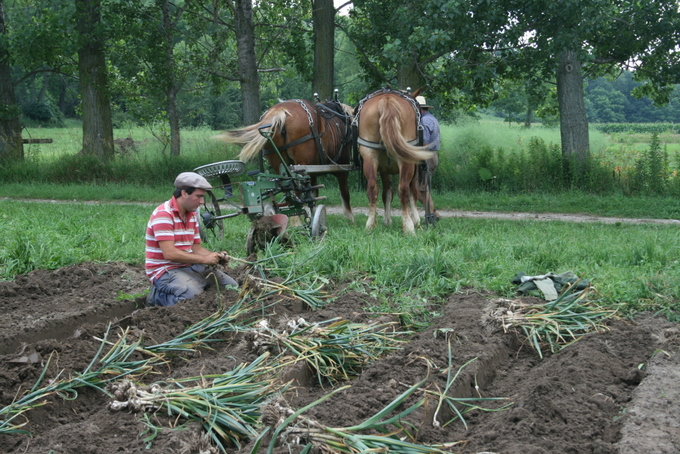
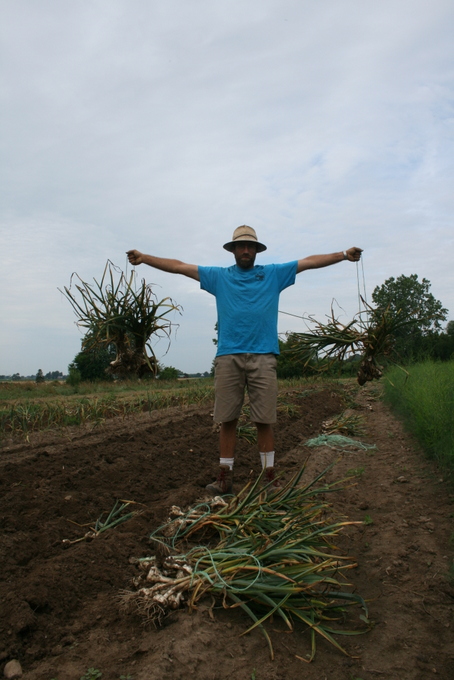
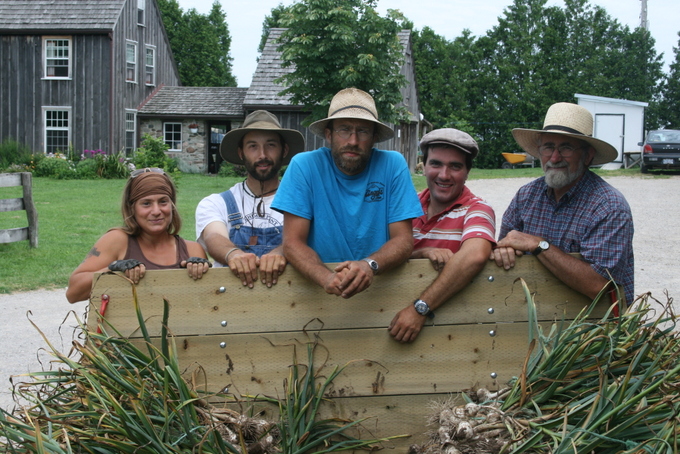
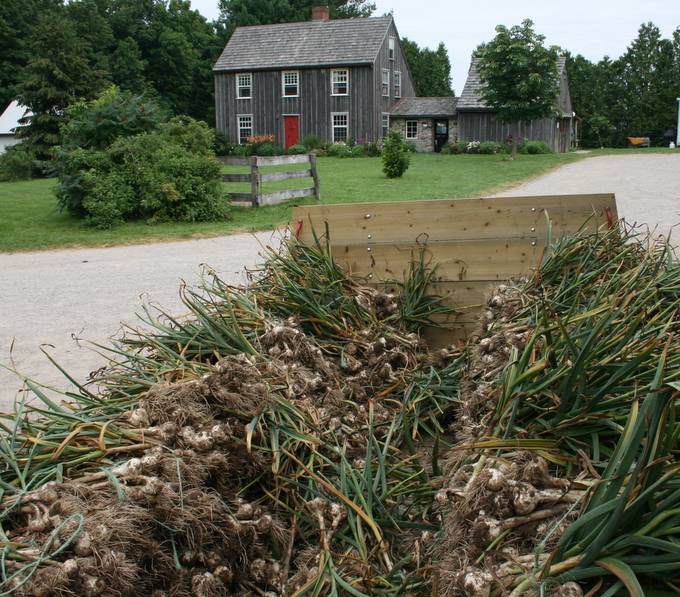
On Monday, we harvested our 2013 garlic crop using our Suffolk Punch horses to plough out the garlic with the riding plough. It worked like a charm and we had all nine – 375 foot rows ploughed out, tied together in bundles and hung up in the barn to dry in three hours. That is a record! Using the riding plough was a great improvement. Here are some pictures of the event!
Ploughing out Garlic with Suffolk Punch Horses
Bill Lifting Garlic Weights Stephanie Tying Garlic Bundles Sam Harvesting Garlic Garlic Harvesters, Stephanie, Sam, Bill Jean Francois, Ken
Yesterday we had about 50 South Western Ontario CRAFT (Collaborative Regional Alliance for Farmer Training) interns from other organic farms in Southwestern Ontario come to our farm. The day included an extensive tour of the farm, pot-luck lunch, a soils workshop and demonstration of various horse drawn implements in the main garden. We enjoyed hosting this group of fine young people who have given the season over to learning about organic farming on various farms in our region.
CSA member Marianne Campbell has shared a couple of recipes that she has enjoyed. With the anticipation of Zucchini coming and for those of you who still have fennel in the fridge and aren’t quite sure what to do with it…keep in mind that any summer squash can be substituted for zucchini.
Zucchini Relish
5 cups ground zucchini with peel
2 cups ground onion
2½ tbsp. coarse (pickling) salt
1 small green pepper, seeded and ground
1 small red pepper, seeded and ground
1¼ cups white vinegar
2½ cups granulated sugar
1 tbsp. celery seed
2 tsp. cornstarch
1½ tsp. dry mustard powder
1½ tsp. turmeric
1½ tsp. nutmeg
¼ tsp. pepper
Combine zucchini, onion and salt in large bowl. Cover and let stand overnight on counter. Drain. Rinse in cold water. Drain. Turn into large pot.
Add remaining ingredients. Heat on medium-high, stirring often, until it boils. Boil, uncovered, for 30 minutes, stirring occasionally. Pour into hot sterilized jars to within ¼ inch of top. Seal. Makes 5 to 6 half pint jars.
Source: Company’s Coming “Preserves” by Jean Paré
Shrimp and Couscous Salad with Fennel
1 ¼ cup whole-wheat couscous
1 ½ cup boiling chicken broth
3 tbsp. olive oil
Zest and juice of 1 large orange
2 tbsp. lemon juice
1 tsp. salt
½ tsp. red pepper flakes
12 large shrimp
½ fennel bulb, diced
½ sweet red pepper, diced
¼ cup toasted slivered almonds
½ cup fennel fronds
Place the couscous in a medium glass or stainless bowl. Pour the boiling chicken broth over top. Stir to combine. Cover with a lid or plastic wrap and let sit for 5 minutes. Fluff with a fork and let cool.
In a medium glass blow, combine the olive oil, orange zest, orange juice, lemon juice, salt and red pepper flakes. Whisk to combine. Add the shrimp and set aside.
When the couscous is cool, add the fennel and red pepper.
Add the dressing with the shrimp. Add the almonds and fennel fronds. Toss well.
Season with salt and pepper, if necessary, and serve.
June always brings with it the big push to get all the main transplanting done. Monday, we got the winter squash and pumpkin transplants planted. Wednesday, with the help of our new horse drawn transplanter, we planted out the melons, summer squash, second succession planting of brassicas and sweet potatoes. Thursday, we were planting the first succesion planting of sweet corn transplants when we got rained out. We are hoping to finish it tomorrow afernoon, if it is dry enough. Today, we covered all the melons and summer squash with row cover (CSA working shares helped too), weeded the hoop houses and started in on trellising the tomatoes all before we began the harvest and washing of the CSA vegetables for tomorrow’s pick-up.
Sam, our apprentice, was cooking supper on Tuesday afternoon, when a CSA member came into the house. The Spinach Casserole he was making smelled so good that the recipe was requested so here it is:
Spinach Casserole
Cook four cups of brown rice
In a skillet, sauté onions and garlic. Add in chopped fresh sage, thyme, and oregano. Add a small bowl of chopped spinach, and stir it in until wilted. In a separate bowl, beat four eggs and combine with two cups of milk and a big handful of grated cheese–I used gouda. Stir the eggs, milk and cheese, and the spinach and seasoning into the rice. Spoon into a greased casserole dish and sprinkle parmesan cheese on top. Bake at 375 for 30 minutes.
We have been working so hard to get the spring work done that the Apprentice Introductions are long overdue. We appreciate all the efforts of everyone on our farm team this spring and look forward to seeing results of all the preparation that has gone into production thus far as the season unfolds. Spring is always welcome after the winter, but it is always an anxious time for me as I care for all the little plants and try to work with the weather not knowing what the spring will be like. Once the seeds and transplants are in the ground and growing I am always relieved. We are almost there now, with the exception of succession plantings. Now I am hoping for some warmer weather to make things grow!
Jean Francois Langlais
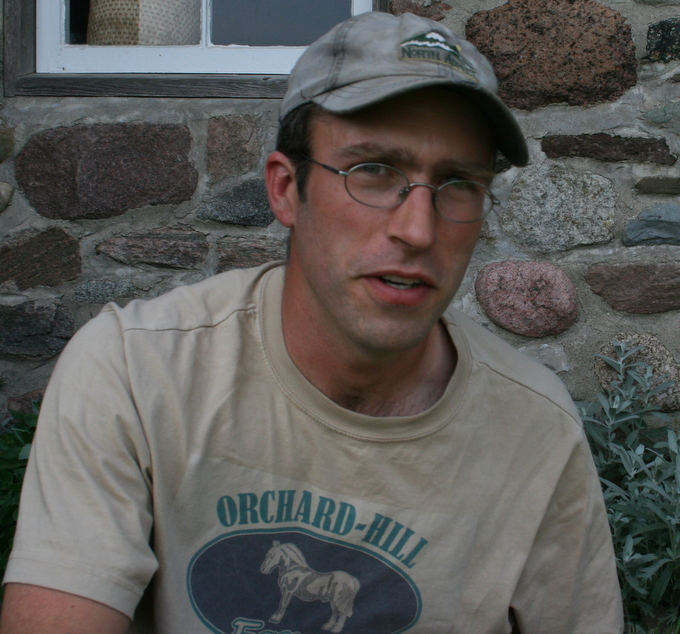
My name is Jean-François Langlais. I come from Québec. I studied organic agriculture at Cegep de Victoraville. I took a break of my studies to come at Orchard Hill Farm and I will finish my programm next winter. I wish to develop more practical agriculture skills and learn more about drafts horses. I wish to have a farm using them later! I want to learn English too, because, as you probably guess, my first language is French! Don’t be shy to talk to me, I enjoy every occasion to meet people and improve my English by the same occasion! See you next time!
Sam Bass
Written by Sam Bass: I am so happy to be here helping in a small way to grow your vegetables on this beautiful piece of land. This is my first month in Canada. I grew up in Austin, Texas, but left home to attend college in Massachusetts, where I studied literature. When I graduated I decided to pursue agriculture, and worked for two years on a vegetable farm in New Jersey. I came to Orchard Hill to learn to work with draft horses, after meeting a former apprentice, Lisa Miskelly, who spoke very highly of the apprenticeship here.
Learning to care for even a small piece of earth is so humbling. All that I do not know and want to learn often overwhelms me. I am deeply grateful to Ken and Martha for allowing young people like myself to come onto a farm and into a home that is so nurturing, and giving so generously of their time and knowledge. I look forward to coming to know you, the members, over the course of the season. You make all of our lives possible by your support. I am sure this farm gives beauty and sustenance to your lives as it does to mine, and it will be good to share its bounty with you.
Stephanie Valiquette
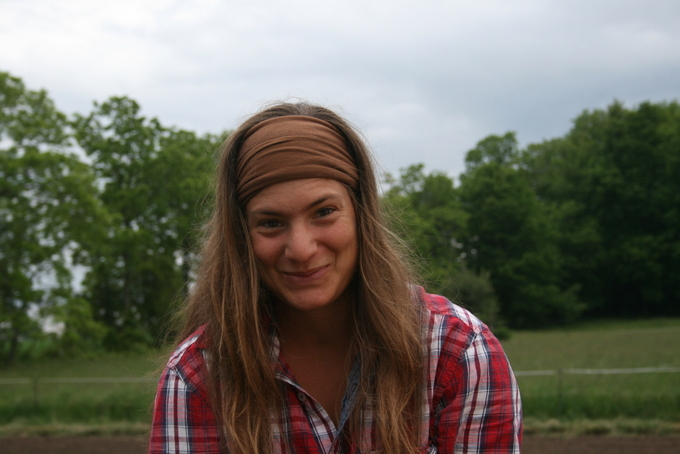
Hi! My name is Stephanie Valiquette. I’m from Quebec. Before I arrived at Orchard Hill Fram I did some fruit picking, dairy farming and did a little market garden with my pony. I’ve studied Organic Farm Management a bit and now I am really enjoying learning here. I’m glad that CSA members come to Orchard Hill Farm to be part of encouraging small diversified farming. I would like to see more farms like this around the world. Farms where we can enjoy good work while empowering ourselves and our communities with good food to root our bodies to the earth. I think farms can be places where we find partnership and sharing to strengthen our humanity. I’m grateful to learn here and meet everyone that is part of the farm, each with their own unique vision and experience. I am looking forward to meeting more CSA members during the summer!
Bill van Zanten
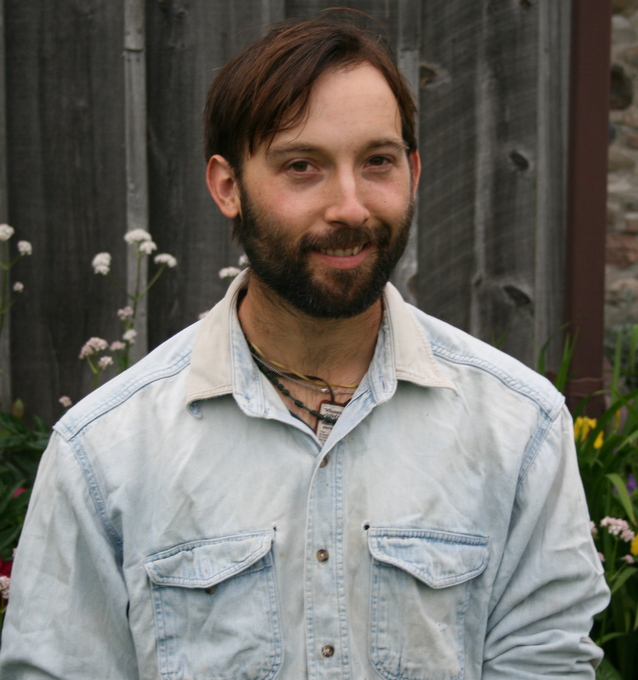
Hi there, Bill here for another year at OHF. Alongside my responsibilities as senior apprentice, I have undertaken a small farm project of my own with the guidance of Ken and Martha. With this project I intend to move toward greater agricultural independence (with the help of some horses of course) and provide fresh food choices for those who would like them. This season I will be offering you the usual pork sausage selections, as well as bacon and whole chickens. Thank you for your support.